What racism, friendship, and applied allyship taught me about the power we carry, the power we overlook, and what we do with it.
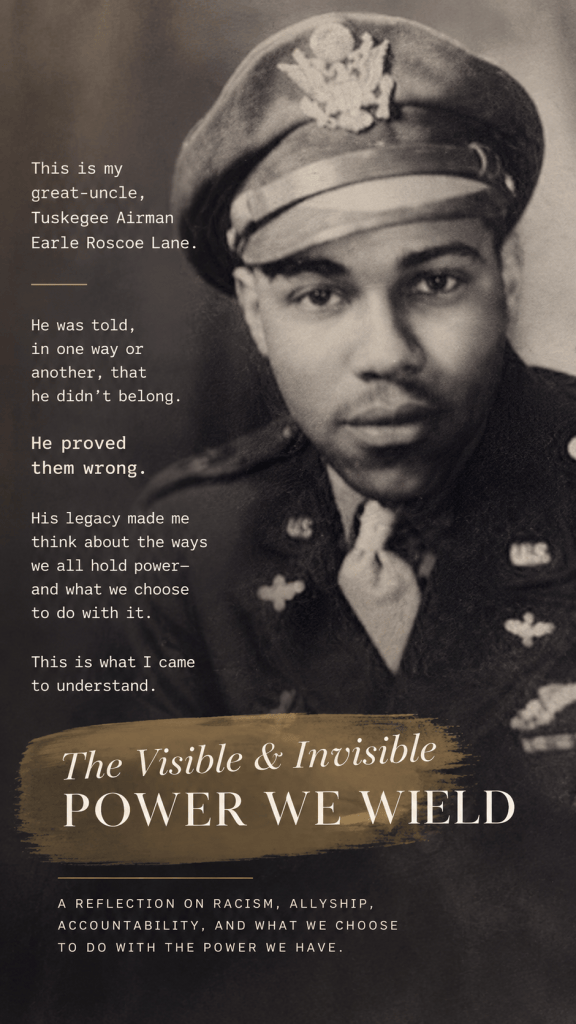
In loving memory of all my ancestors, the slave and free, my Grandpa James Sanders, my Grandmother Mary Magdalene, my Grandmother Billie Ann, and my Great Uncle Earl Roscoe Lane.
Author’s note: If you are going through this, please know you are not alone, and it is okay to step into your personal power.
I recently found myself questioning friendships with people whom I once considered progressive, socially aware, and safe. Moments had already made me question where I stood in these friendships and whether I was being understood or included the way I thought I was. But one conversation made these concerns unavoidable.
What made this specific moment so significant was what happened within it. I genuinely believed these were people who understood why these conversations mattered. I trusted their values and my perceived understanding of their definitions of racism and allyship; I believed that when something hurt me, I could say so without becoming the problem. Instead, the conversation brought the larger disconnection into greater clarity.
I now find myself wondering what moving from awareness into applied allyship actually looks like. Particularly, when supporting someone means sitting with discomfort, examining your own reactions, balancing intention and impact, and choosing not to retreat because the conversation is challenging.
After I expressed how deeply hurt and disturbed I was, the group went silent.
This silence has taught me more about allyship than any conversation about progressive values ever could.
When Values Become Personal
One of the most uncomfortable feelings to sit with is knowing how much I trusted what people said about their values. One individual in particular works in data science for insurance and openly acknowledged that her work can and does negatively impact Black communities. I took this awareness seriously. I believed it meant that racial harm is not always obvious or intentional, and that she could identify these dynamics within a friendship as well.
Other moments made me uncomfortable before this incident. This individual described protecting herself through financial security, acknowledged that she was not vocal or well educated about injustice and political violence, and stated that she has little interest in educating herself because it is uncomfortable. Having the ability to insulate yourself financially from certain realities, the ability to choose not to engage when others DO NOT have that same ability to turn a blind eye, can itself shape how harm is experienced.
There were also openly classist remarks made about her mixed cousins and the circumstances they are living in. Her cousin had been raised in poverty by a mother (a white woman) who neglected them socially, financially, and emotionally. As adults, her cousins are now facing homelessness due to these circumstances in their past. They (her cousins) had no say in it or understanding of the future implications because they were children. Yet, my friend seemed to view her father’s attempts at “tough love”, by encouraging the cousin to enlist in the military to avoid homelessness, as something the cousins should respond well to. What stayed with me was how easily their circumstances became secondary to individual responsibility. Poverty, neglect, and instability were being reduced to a question of whether they were making the right choices. This reminded me of intersectionality, how race and class cannot always be dissected or separated from one another. The American Psychological Association (n.d.) describes intersectionality as the way forms of oppression, including racism and classism, are interconnected and cannot be examined separately from one another. To me, this was another example of the harm I started noticing, not proof that she was a bad person or that I knew where her values were.
I did not immediately turn these observations into a judgment about who she was. I believe people can have blind spots, cause harm without intending to, and still be capable of listening and a willingness to reflect. I was/still am, not looking for perfection. I was looking for the ability to recognize impact, take accountability, and to remain open when someone explains that something hurt them.
I also tried to create room for this kind of learning. Days before these events unfolded, I shared Robin DiAngelo’s White Fragility and Nice Racism, as she seemed interested in becoming more aware of implicit biases and racism. I, once again, did not expect anyone to become an expert on controlling implicit biases overnight. I was hoping for curiosity, reflection, and a willingness to understand why something had hurt me, even if harm was not intended. The response I received was, “Oh girl, I didn’t mean it like that.” This only furthered the feeling of minimization, invalidation, and dismissiveness.
In another earlier conversation about race, this individual asked whether it was rooted in white supremacy to expect everyone to treat her with dignity, respect, and niceness. I agree that everyone deserves dignity, respect, and niceness. What I challenged was the ideology beneath the belief, showing how ideas about fairness and respect can become disconnected from the racial realities that shape who is actually afforded those things.
The workplace advice situation became another moment that made me think about credibility and whose perspective is trusted. She came to me and the only other POC for advice after a coworker had consistently undermined and circumvented her. I shared my workplace perspective, and the other group member agreed the advice was sound. At the time, this felt like a normal example of the established trust and mutual respect in our relationship.
Later that same evening, however, she and I were at another mutual’s house. During this time, she explained that she looked up what she could and could not report to HR, essentially double-checking the advice I had given her. On its own, verifying workplace information is not problematic. What lingered with me was the contrast. She sought my professional judgment, but then felt the need to verify it independently.
By this point, these moments were no longer happening in isolation for me. The earlier conversation about race had already made me question whether my perspective was being given the same credibility when I was speaking about racial harm. This workplace advice situation didn’t create the concern, but it gave me another concrete data point. It forced me to confront something I had been trying not to conclude: this level of unawareness made it hard for me to see this person, and by extension the group, as safe people to stay closely connected to.
As conversations surrounding resolution went on, this distinction became increasingly difficult for me to ignore.
What the Fuck is an appropriate response to these situations?
No seriously, what the fuck is an appropriate response in these situations? The hardest part for me was not only identifying that something hurt me. It was trying to figure out what an appropriate response looked like after I communicated that harm and explained the emotional impact that it had on me, including the suicidal ideation.
I also had to confront something painful: my response to what happened ultimately contributed to the end of the friendships. This has made me question where the line is between communicating the harm of implicit bias and being expected to communicate it in a way that remains comfortable for everyone else.
I am very aware of how intense my emotions were and how they affected my communication. I know that the way I communicated these emotions was never going to be perfect. But I also began to feel like my reaction to implicit bias was being policed. There seemed to be an unspoken expectation that, in order for my hurt to be acknowledged, I needed to present it in a way that was calm enough, measured enough, and familiar enough to whiteness to be considered reasonable.
These two realities are difficult to sit with.
Because what does it mean if I have to make my response to implicit biases and racism comfortable for the people who are hearing about it before my experience can be taken seriously? At what point does “communicate more effectively” become another way of asking the person experiencing harm to manage everyone else’s comfort?
Once again, not asking anyone to agree with every interpretation I had or immediately know the perfect ally thing to say. I was trying to communicate that something had caused real harm. I had tried to explain what happened. I had shared resources. I was looking for some indication that the impact mattered.
So what is an appropriate response when someone communicates these feelings of racial harm to you?
I don’t have the answer, but this is what I hope would happen:
- Listening before defending
- I hoped there would be an effort to understand what I was actually saying before focusing on intent, tone, or whether my interpretation was fair
- Acknowledge the impact
- I did not need anyone to agree that this individual is a bad person who deserves to be cut off or that everything they did was intentionally racist. I needed someone to say, “I can understand why that hurt you.”
- Ask questions instead of making assumptions
- If something I said was unclear, I believe the obvious next step is to ask a question instead of filling in the gaps. There should be more grace and understanding for me to explain my experience without feeling like I have to prove I was entitled to feeling hurt and ending the relationship.
- Allow emotions to exist
- I know my emotions were intense. I also know that the way I communicated them was not always perfect, especially when I was struggling emotionally. But I didn’t want the intensity of my response to become the main issue while the implicit bias that led to it became secondary.
- Do not make me responsible for making implicit bias and racism comfortable to discuss
- I began to feel as though my reaction was being policed.
- Further, in order for my experience to be acknowledged, I had to explain it calmly enough, gently enough, or in a way that appealed to witnesses enough to make everyone else comfortable
- Stay present
- I did not expect everyone to know exactly what to say. I would have understood someone saying, “I don’t fully understand this yet, but I can see that you’re hurting, and I want to understand.” What mattered was the willingness to stay in the conversation rather than retreat.
- Reflect on what happens next.
- Acknowledging harm doesn’t mean agreeing with every interpretation or accepting that you are a bad person. It means being willing to ask, “What can I learn from this, and what can I do differently?”
What I now know I was looking for most was not perfection, but care. This isn’t to say that no one actually cared. The care I received didn’t always feel like the kind I needed in that moment. I needed care that made room for discomfort, accountability, and the reality of what I was trying to communicate. I needed to feel that my pain mattered even when my reaction was difficult to understand. I needed people to care enough to stay present, ask questions, and try to understand rather than simply distance themselves from the discomfort.
Why I Thought Of Serena Williams
During the 2018 U.S. Open final, William challenged the chair umpire after receiving a coaching violation and was ultimately penalized following the series of disputes. What resonated with many Black Women was the familiar expectation to monitor their tone and emotions when speaking up.
That dynamic felt and still feels all too familiar. Especially when, during a previous conversation, another member of the group asked why I was always so angry. The question stood out to me because, moments prior, we were discussing stereotypes of the angry black woman, yet I was being asked to explain or justify my anger in the same conversation.
I, now, find myself asking a much smaller, more personal version of the same question. How do I advocate for myself without becoming the problem because someone is uncomfortable with how I said it?
This question brought me back to Robin DiAngelo’s White Fragility. DiAngelo states, “It is white people’s responsibility to be less fragile; people of color don’t need to twist themselves into knots trying to navigate us as painlessly as possible.”
I will hold this quote tightly as I move forward. I realize how much I had been trying to do exactly that: explain my hurt while also making sure everyone else was comfortable hearing it, and I don’t think I should have to.
The Comfort of Niceness
I also kept thinking about the idea of niceness. In recent years, there have been debates on if nice people are actually good people. We all know people who avoid saying what truly needs to be said because they want to be perceived as nice (I am talking about myself).
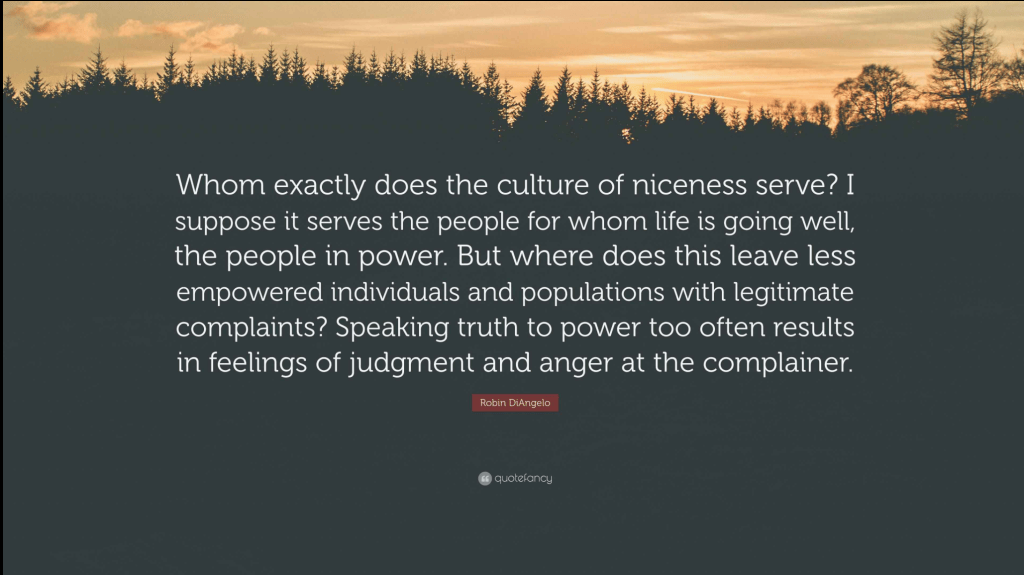
In Nice Racism, DiAngelo asks, “Whom exactly does the culture of niceness serve?” DiAngelo points to the way calls for harmony can place a burden on less empowered people to soften legitimate complaints so that people with more social power do not have to feel uncomfortable.
This distinction mattered to me. I wasn’t asking anyone to hate someone, take sides, or declare me the winner. I wanted honest conversation about what happened and why it hurt.
I preferred a group conversation because I worried that handling everything privately would leave me feeling invalidated or isolated.
What I needed was not perfection. I needed people to stay present.
Old Habits Die Hard
In the past, I avoided calling out anti-blackness because I thought it was easier to adapt than to challenge it. At this stage in my life, I made a conscious decision to respond differently, although I never really knew what that would look like. In this situation, part of me operated from the mindset of, “If you can’t beat them, join them.” I learned to swallow discomfort, soften my reaction, and keep the peace.
For a long time, this was my primary survival strategy. If I could make myself smaller, quieter, or easier to understand, maybe I could avoid the conflict that naturally comes with speaking up. What I didn’t always consider was what constantly carrying that burden did to me.
That has made me think differently about the cost of self-silencing because the reality is that every time an insensitive comment was made, I had an opportunity to address it. Research on Black Women has connected experiences of racial discrimination with chronic stress and physiological dysregulation. One study in particular found that Black women had the highest predicted levels of allostatic load, a measure of cumulative physiological wear and tear associated with chronic stress (Thomas et al., 2019).
The study does not directly show that suppressing emotions itself causes chronic illness, and its findings about the relationship between allostatic load and discrimination are far more complex. But it reinforces something I already understood: racial stress does not become harmless simply because you learn how to manage it or make it appear manageable.
I have spent a lot of time trying to make difficult situations easier for other people to sit with. I am learning that doing so constantly can mean becoming the person who absorbs the discomfort instead.
Sometimes keeping the peace simply means carrying the cost of that peace yourself.
My Understanding of Allyship Now
I left this situation with a new perspective on what, for the purposes of this reading, I will call applied allyship. Applied allyship is the difference between holding progressive beliefs and putting them into practice, with the understanding that doing so requires discomfort, self-reflection, and/or accountability. Being progressive is not the same as being an ally. Using the right language, supporting equality in theory, identifying with progressive values, or voting for a progressive politician does not automatically translate into how someone responds when those values become uncomfortable or personal.
Allyship often gets tested when there is something to lose: comfort, certainty, social ease, not wanting to be doxxed for being racist, the ability to believe that you are one of the good people. It requires more than agreeing with the principle. It requires staying patience when someone tells you that something you did or said caused harm.
I also understand that relationships can survive the harm of implicit bias. They can survive misunderstandings, poorly handled conversations, and moments when someone gets defensive or gets something wrong. What relationships cannot survive indefinitely is a pattern of the same underlying issues without reflection, accountability, or meaningful change.
That distinction matters most to me now. I am not saying this friendship changed because of one comment. I am saying the harm I had already noticed, the workplace situation, the later comment and defensiveness, the context surrounding it, and what happened afterward forced me to see the relationship differently.
What I will look for in friendships moving forward
I think friendship reveals values in a way that statements and labels such as democrat or republican cannot (they both deserve to be lowercase fuck the two-party system). I will place less emphasis on what someone says they believe and more attention to what those beliefs require them to do when the situation becomes uncomfortable.
I will look for people who can listen without needing to defend themselves from being labeled a racist. I am looking for people who can recognize they cause harm via racial insensitivity, stay present through discomfort, and make a genuine effort not to repeat it. People who acknowledge harm caused by racial insensitivity without making the person who experienced it responsible for comforting them. People who understand that accountability is not the same thing as condemnation.
Most of all, I will look for consistency.
I have learned that people can speak beautifully about equality, inclusion, and allyship until practicing those values requires leaving privilege, legacy, and their own understanding of the situation and events that took place in equal regard to a POC’s experience. No singular event tells you everything about a relationship, but the event, the surrounding context, and what happens afterward can reveal a pattern.
Relationships with POCs do not need perfection to survive. They need honest conversations about implicit bias, repair, and a willingness to change the pattern.
Sometimes, the lesson is realizing that shared values do not automatically create understanding. What matters is what people are willing to do when those values require discourse, accountability, and care.
Conclusion
We all, in some way, shape, or form, uphold white supremacy, including me. I think it is important to say that because recognizing racism, implicit bias, and white supremacy cannot only mean identifying what other people do. It requires being honest about the ways WE HAVE EACH shaped the system around us.
For full transparency, an example of this is that when we moved to Mississippi, it had a very large Black population, but because of my parents’ engagement and success in the system of white supremacy, my brothers and I were often in majority-white spaces. We attended schools with the best reputations, participated in competitive sports and academic programs, and had access to opportunities that placed us around predominantly white communities.
I remember one moment particularly well. My mom was driving us around our new town when she needed to stop for gas. The gas station was in what I understood to be a not-so-great part of town, and the surrounding area was primarily Black. My mom accidentally left her card at home, so she had to go inside to pay and left my brothers and me in the car.
There were people outside the gas station, mostly just standing around minding their own business. But here I am at 9, wailing in the car because seeing that many Black people made me feel unsafe… and I am black.
Looking back as an adult, I can laugh at the absurdity of that moment because I can see what I was taught without anyone explicitly teaching me. I absorbed the association between Blackness, poverty, and danger. I learned to understand certain neighborhoods as unsafe without understanding why. I was socialized into a worldview where proximity to whiteness felt normal and proximity to Blackness felt threatening.
The last layer to this story that I find most hilarious now is that my parents should have put me around more Black people who were not also accustomed to navigating predominantly white spaces. I had plenty of exposure to Black people who occupied the same majority-white environments I did, but much less exposure to the full range of Blackness and the experiences that existed around me and were a part of my lineage.
Let this experience be the reminder that racism is not always something we consciously choose. Sometimes we inherit it, absorb it, reproduce it, and have to actively unlearn it.
This further clarifies why I don’t think the goal of allyship should be proving we are good people who have never participated in harmful systems. None of us get to claim that kind of innocence. Now, the central question is: what do we do once we recognize the ways we have been shaped by those systems?
This is what I mean by applied allyship.
It is the difference between believing in progressive values and actually practicing them. It is easy to believe in equality when these beliefs cost us nothing. It becomes much harder, even for me, when practicing those values requires listening to someone whose experience challenges our understanding and acknowledging harm (even unintentional) without defending ourselves, or examining a part of ourselves that we would rather believe is already resolved.
I am still learning how to do that myself.
But I know now that I do not want to be someone who only recognizes racism when it is obvious, intentional, or committed by someone else. I want to be more willing to recognize the ways I have participated in and benefited from systems I did not create, and the ways I may still have things to unlearn.
Because if allyship only exists when we are comfortable, then it is not really being applied.
I am thankful this experience forced me to reflect on broader social implications as well as my own. I have much more self-awareness due to it. In the future, I hope to keep meeting people who have met themselves and their biases as deeply as I have.